Some family stories are not really about what happened yesterday. They are about everything that remained unsaid for years.
Beej, a new Punjabi short film now streaming on Chaupal, explores one such story. The film follows a nephew who returns to his uncle after a generation of silence, bringing back memories of a time when the family was still together before a bitter dispute over land changed those relationships forever.
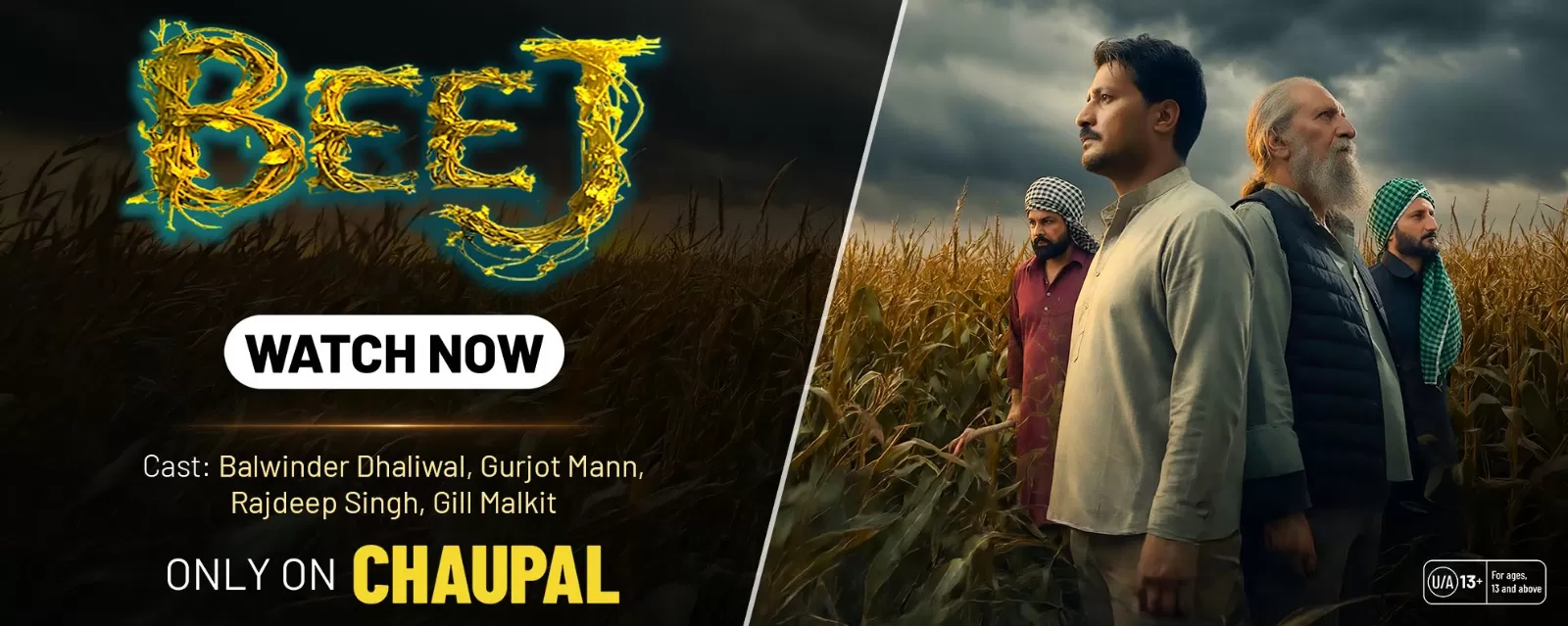
Directed and written by Manshendra Singh Kailey, Beej brings together Balwinder Dhaliwal, Gurjot Mann, Rajdeep Singh and Gill Malkit in a drama that looks at family, memory, conflict and the lasting impact of decisions made in the past.
With a runtime of around 60 minutes, Beej offers a compact Punjabi story built around a deeply personal family conflict.
What Is Beej About?
At the centre of Beej is a family divided by a bitter land dispute.
A generation has passed since the conflict created a distance between family members. During that time, memories of what the family once was have remained buried along with the bitterness that came from the dispute.
The story takes a turn when a nephew returns to his uncle.
His arrival brings the past back into the present. Memories of the days before the family was divided begin to resurface, forcing the characters to confront a relationship and a history that have remained unresolved for years.
Rather than being a story about land alone, Beej looks at what can happen when a dispute changes the way people see their own family.
A Story About Family and Old Wounds
Land disputes can have consequences that go far beyond property.
When disagreements enter a family, they can change relationships, create resentment and turn people who once shared the same home into strangers. In Beej, that separation stretches across a generation.
The nephew’s return becomes important because it brings back memories of a different time, before the dispute created the distance between the family members.
This gives the film an emotional foundation. The question is not simply what happened between them, but whether the passage of time can change the way they look at what happened.
Why the Title Beej Is Interesting
The title Beej, meaning “seed”, fits naturally with a story about something that begins small but can grow over time.
A disagreement, a decision or a moment of bitterness can sometimes have consequences far beyond what anyone expects at the beginning. In a family, those consequences can continue from one generation to the next.
The title therefore adds another layer to the film’s central idea: some things are planted in the past, but their effects can continue to be felt much later.
The Return That Brings the Past Back
The nephew’s return is the event that sets the story in motion.
After years of silence, his presence creates an opportunity for memories that had been left behind to come back into focus. The uncle is forced to confront a past that has remained part of the family’s history, even if nobody has spoken about it for years.
This makes the reunion more complicated than a simple meeting between relatives.
There is history between them, and that history is what gives the story its emotional weight.
Balwinder Dhaliwal Leads the Cast
Balwinder Dhaliwal is part of the principal cast of Beej, which centres on a family carrying the consequences of a long-standing conflict.
The film’s relatively intimate scale allows its characters and relationships to remain at the centre of the story. With much of the narrative built around the past and its impact on the present, the performances play an important role in conveying what the characters have left unsaid.
Gurjot Mann, Rajdeep Singh and Gill Malkit
Gurjot Mann, Rajdeep Singh and Gill Malkit also feature in Beej, completing the film’s principal ensemble.
With a story built around family relationships and a conflict that has continued across generations, the supporting characters are an important part of understanding the world of the film.
Rather than relying on a large cast or multiple storylines, Beej keeps its focus on the people connected to its central conflict.
Manshendra Singh Kailey Directs and Writes Beej
Beej is both written and directed by Manshendra Singh Kailey.
Taking charge of both the screenplay and direction gives the film a consistent creative voice, particularly for a story that depends heavily on its characters and emotional history.
The short-film format also allows the story to remain focused. With a runtime of approximately 60 minutes, Beej has enough space to explore its central conflict while keeping the narrative centred on the family at its heart.
Beej: Movie Details
| Detail | Information |
| Movie | Beej |
| Release Year | 2026 |
| OTT Release Date | 23 September 2026 |
| OTT Platform | Chaupal |
| Language | Punjabi |
| Genre | Drama |
| Runtime | Approximately 60 minutes |
| Director | Manshendra Singh Kailey |
| Writer | Manshendra Singh Kailey |
| Lead Cast | Balwinder Dhaliwal, Gurjot Mann, Rajdeep Singh, Gill Malkit |
| Certification | U/A 13+ |
What Makes Beej Different?
Not every Punjabi story needs a large-scale setting or a fast-moving plot.
Beej takes a much more personal route. Its conflict comes from a family relationship that has been damaged over time, making the emotional history between its characters more important than spectacle.
The idea of a family remaining silent for a generation also gives the film a sense of mystery. What exactly happened before the separation? What memories have been carried forward? And what does the nephew’s return mean for the relationship between the family members?
These questions give the story its intrigue without requiring an elaborate premise.
A Punjabi Short Film About Things Left Unsaid
One of the most relatable aspects of stories about family conflict is that the biggest problems are not always the ones people talk about.
Sometimes, years of silence can say as much as an argument.
Beej uses that silence as an important part of its story. The distance between the characters is not simply physical. It is the result of years of memories, resentment and unresolved feelings.
The nephew’s return changes that equation and gives the characters a chance to revisit a chapter of their lives that they may have wanted to leave behind.
Where to Watch Beej?
Beej is now streaming on Chaupal from 23 September 2026.
Viewers looking for Punjabi stories beyond mainstream feature films can watch the short film on Chaupal and explore the platform’s wider collection of new Punjabi movies and regional entertainment.
The film’s approximately 60-minute runtime also makes it an easy choice for viewers looking for a focused story that can be watched in a single sitting.
Why You Should Add Beej to Your Watchlist
If you enjoy Punjabi dramas that focus on family relationships, emotional conflicts and stories rooted in real human experiences, Beej offers a different kind of watch.
The film does not begin with a family that is already united. Instead, it starts with the consequences of a separation that has lasted for years.
That gives the story an interesting starting point. The audience is not simply watching a family grow closer. They are looking at what remains after a family has been divided, and what happens when someone finally returns to reopen that chapter.
Final Thoughts
Beej takes a simple but emotionally layered premise and builds it around one of the most complicated things in life: family.
A land dispute may have been the reason the characters were separated, but the story is ultimately about what happens after the dispute, when years pass and the people involved have to live with what happened.
With Manshendra Singh Kailey handling both the writing and direction, and a cast led by Balwinder Dhaliwal, Gurjot Mann, Rajdeep Singh and Gill Malkit, Beej brings a focused Punjabi drama to Chaupal.
The film is now streaming on Chaupal, giving audiences a chance to discover a story about family, memory, silence and the consequences that can travel from one generation to the next.